
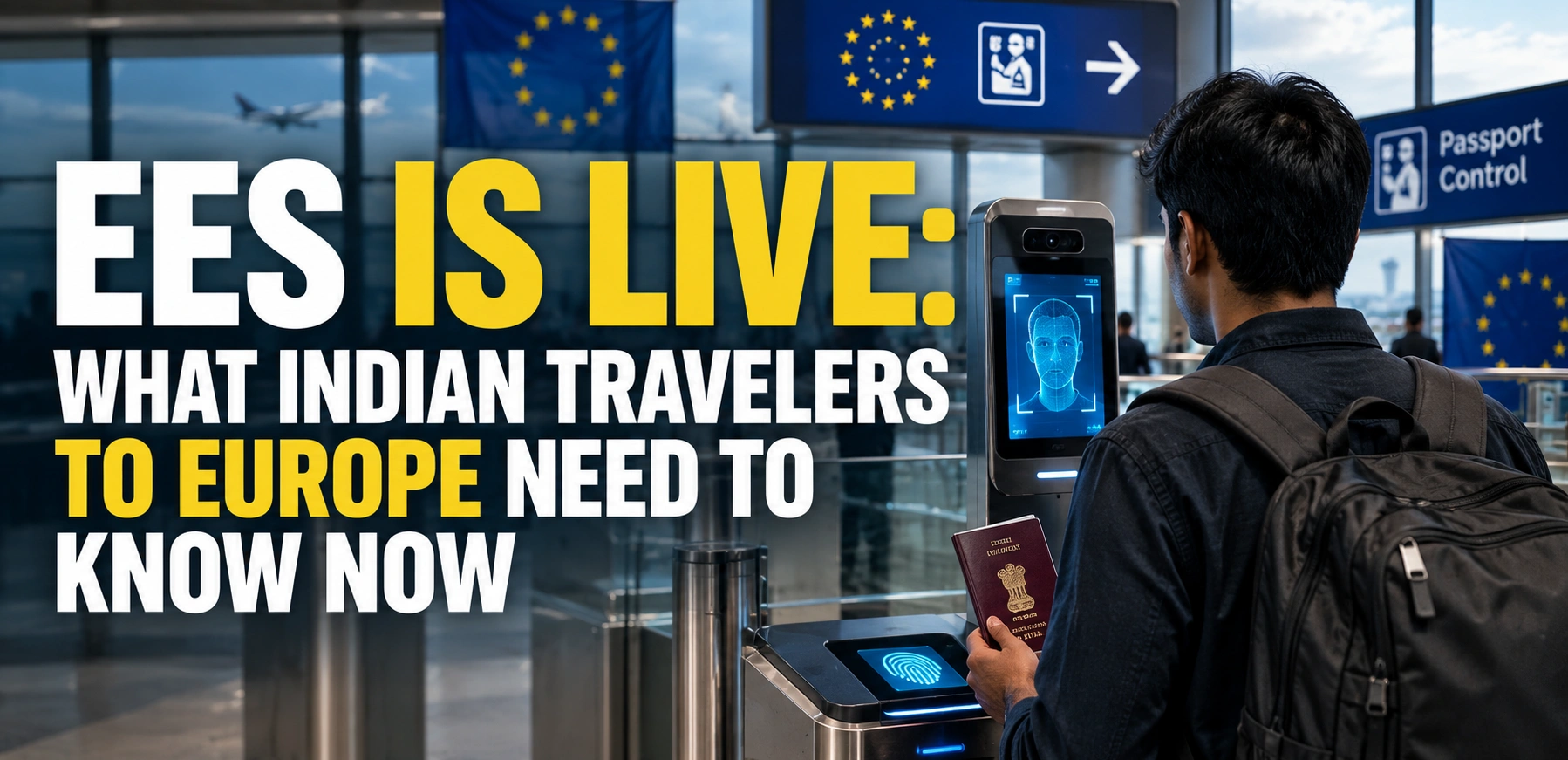
The Entry/Exit System (EES) went live across all 29 Schengen countries in April 2026, replacing manual passport stamps with automated biometric registration — fingerprints and a facial scan — at the border. For Indian travelers, this means your first crossing into the Schengen Area will take a few minutes longer than before, but nothing about your visa application process itself has changed. If you’re applying for a Schengen visa from Mumbai right now, the current document requirements, application centre process, and fees still apply exactly as they did before EES.
Quick Facts Snapshot
- EES has been live across all 29 Schengen countries since April 10, 2026, replacing manual passport stamping with biometric entry/exit records.
- EES applies to short-stay, non-EU travelers, including Indian passport holders — both visa-required and visa-exempt nationals.
- The optional “Travel to Europe” mobile app launched in March 2026, letting travelers pre-register passport and facial data up to 72 hours before reaching an EES border point — currently available at Sweden’s entry points, with other countries following.
- ETIAS, the separate pre-travel authorization step, is not required yet — its expected launch was pushed from Q4 2026 to a likely 2027 date.
- Schengen visa fees remain unchanged at €90 for adults as of the 2026 update; children aged 6–12 pay €45, and children under 6 travel free.
- Your 90/180-day stay limit hasn’t changed — EES simply tracks it digitally instead of through passport stamps.
Table of Content
- What Is EES and Why Did It Launch?
- How Does EES Affect Your Schengen Visa Application?
- What Happens at the Border Under EES?
- Does EES Change the 90/180-Day Rule?
- Is ETIAS Also Required Now?
- How Should Indian Travelers Prepare?
- FAQs
What Is EES and Why Did It Launch?
EES is an EU-wide digital border system that records biometric data — fingerprints and a facial photo — every time a non-EU traveler enters or exits the Schengen Area, replacing the old system of manual passport stamps. The system was designed to close a long-standing gap: with paper stamps, border officials had no fast, reliable way to check whether someone had overstayed the 90/180-day limit. EES solves that by creating a digital, timestamped entry-exit record tied to your passport and biometrics.
For most Indian travelers, this is the most immediately practical Schengen change of 2026 — more relevant day-to-day than the digital visa rollout or the India-EU Mobility Pact, both of which are still in phased implementation.
Pro Tip: First-time EES registration takes longer than a standard stamp — budget an extra 5–10 minutes at immigration on your first entry. Subsequent crossings within the same passport’s validity are typically faster since your biometrics are already on file.
How Does EES Affect Your Schengen Visa Application?
Your Schengen visa application process has not changed because of EES — you still apply through the same visa application centre, with the same documents, at the same fee. EES is a border-entry system, not a visa-issuance system, so it doesn’t add new paperwork to your application.
What has genuinely shifted in 2026 is separate from EES:
The practical takeaway for applicants: don’t assume any of these headline changes mean you need different documents today. Apply exactly as you would have a year ago, and let your consultant flag anything that shifts.

What Happens at the Border Under EES?
At your first Schengen entry after EES, you’ll be directed to a self-service kiosk or an officer who records your fingerprints and takes a facial photo, which is then linked to your passport for the duration of your visa or visa-free stay. This replaces the old ink stamp entirely at EES-active crossings.
A few things worth knowing before you fly out of India:
- Registration is required only once per passport, typically — subsequent trips reuse the stored biometric data until your passport changes.
- Airlines now carry stricter carrier obligations under the revised Schengen Borders Code, so make sure your passport meets validity rules before check-in, not just before landing.
- The optional pre-registration app can shave time off your first crossing, but it’s currently limited to specific entry points, so check availability for your arrival airport before relying on it.
Pro Tip: If you’re connecting through a Schengen hub (Frankfurt, Amsterdam, Paris) with a tight layover, EES registration on arrival can eat into your connection buffer. Build in at least 45–60 extra minutes on your first Schengen entry.
Does EES Change the 90/180-Day Rule?
No — the 90/180-day rule itself is unchanged: you can still stay a maximum of 90 days within any rolling 180-day period across the combined Schengen Area. What’s changed is how that count is tracked. Previously, border officers manually checked passport stamps to estimate your days used. Now, EES calculates it automatically from your digital entry-exit record, which makes overstays far easier to detect and enforce.
This matters more for Indian travelers than it might seem — a passport that shows a slightly-off stamp date used to leave some room for manual interpretation. EES removes that margin entirely.

Is ETIAS Also Required Now?
No — ETIAS is not yet required for Schengen entry. It’s a separate pre-travel authorization step that was expected to launch in Q4 2026, but that timeline was removed in July 2026, with 2027 now considered the likely launch date. ETIAS will eventually function similarly to the US ESTA — a low-cost, pre-approved authorization for visa-exempt travelers before they board a flight to Europe. It’s a different mechanism from EES: think of EES as the border check happening inside the airport, and ETIAS as a pre-clearance step that would happen before you even book your ticket.
Since Indian passport holders already require a Schengen visa for most short stays, ETIAS will mainly affect visa-exempt travelers once it launches — but it’s worth tracking if you also travel on a second passport.
How Should Mumbai Travelers Prepare?
The single most useful thing to do before your next Schengen trip is confirm your passport meets the updated validity and issue-date rules, since EES enforcement leaves no room for border-side flexibility. Beyond that, treat your application exactly as before — the paperwork hasn’t changed, only the border experience has.
For applicants working with a consultant near Kandivali West, this is also a good moment to check whether you qualify for the 2-year or 5-year multi-entry cascade visa, since repeat travelers with a clean visa history are increasingly being approved for longer validity in 2026 — reducing how often you need to reapply and go through EES registration from scratch.
Pro Tip: If your last Schengen visa was approved before 2021 and your biometrics haven’t been refreshed since, budget extra time at your application centre — you’ll need new biometric capture regardless of EES.
Ready to Apply for Your Schengen Visa?
EES has changed the border experience, not the paperwork — but getting your documents right the first time still matters more than ever under stricter biometric enforcement.
Siddhivinayak Tours and Travels makes it easy to apply with confidence, with document checklists and eligibility checks tailored to the latest 2026 rules. Book your consultation at our Kandivali West office today
Skip the Mumbai Traffic! Get Visa Assistance at Your Doorstep
No need to visit our office. Our specialists will visit your home or office for document verification and processing.
*Additional service charges applicable based on your location.
Does EES apply to Indian citizens traveling on a Schengen visa?
Yes. EES applies to all non-EU short-stay travelers, including Indian visa holders. Your fingerprints and facial photo are recorded at your first entry after April 2026 and linked to your passport for the visa’s validity.
Do I need to do anything differently when applying for my Schengen visa because of EES?
No. EES is a border-entry system, not a visa-application requirement, so your documents, application centre process, and fees stay the same as before.
Is the €90 Schengen visa fee going up because of EES?
No. The adult Schengen visa fee remains unchanged at €90 as of the 2026 update, last revised in June 2024 from €80. No further increase has been announced for 2026.
Will EES make my first trip to Europe slower?
Slightly, on your first entry only. Expect 5–10 extra minutes for biometric registration at the border; later trips on the same passport are typically faster since your data is already stored.
Is ETIAS required alongside my Schengen visa now?
No. ETIAS has not launched yet — its expected date moved from Q4 2026 to a likely 2027 rollout. Indian visa holders don’t need it for current applications.
Does EES affect the 90/180-day stay limit?
No, the limit itself is unchanged at 90 days within any rolling 180-day period. EES only changes how that limit is tracked — digitally instead of through manual passport stamps.
Can I use the pre-registration app before flying from Mumbai?
The “Travel to Europe” app is currently available mainly at Sweden’s entry points, with other countries adding it in phases. Check availability for your specific arrival airport before relying on it.
I applied for my Schengen visa in 2025 and got approved — is it still valid under EES?
Yes. Existing valid visas are unaffected by EES. You’ll simply undergo biometric registration at your first entry after the system’s April 2026 launch.
Should I apply for a multi-entry visa instead of a single-entry one now?
If you travel to Europe more than once every year or two, ask your consultant about the 2-year or 5-year multi-entry cascade visa — it’s fully active in 2026 for eligible repeat applicants and reduces how often you need to reapply.
Where can Kandivali-area travelers get help understanding these changes?
Siddhivinayak Tours and Travels, based in Kandivali West, tracks Schengen policy updates as part of every visa consultation and can confirm exactly which 2026 changes apply to your specific application.