
VFS Global — the world’s largest visa outsourcing company, handling Schengen applications for over 1 million Indians annually — is under active EU scrutiny following a five-year investigation that exposed biometric data stored on unencrypted discs, appointment slots sold through bot networks, GDPR violations at its New Delhi and Mumbai centres, and systematic coercion of applicants into optional paid services. The investigation, published May 27, 2026 by Lighthouse Reports and Indian Express, is based on 150+ internal EU inspection reports spanning 2020–2025, obtained through 40+ Freedom of Information requests filed across the European Commission and 11 EU governments.
Table of Content
- What Is VFS Global — and Who Actually Owns It?
- What Did the EU Investigation Actually Find?
- The Data Security Crisis: Biometric Data on Unencrypted CDs
- Fake Appointment Slots and Bot Networks: How the System Is Being Gamed
- The Optional Services That Didn’t Feel Optional: VAS Coercion at Delhi and Mumbai
- Visa Shopping, Forged Documents, and Processing Errors at New Delhi VAC
- What VFS Global Says — and What the Reports Found
- What the EU Is Doing About It — and What Comes Next
- What Indian Schengen Applicants Must Know Right Now
- FAQs: VFS Global Schengen Visa Controversy 2026
What Is VFS Global — and Who Actually Owns It?
VFS Global is the world’s largest visa outsourcing and technology services company. Founded in 2001 and headquartered in Zurich, Switzerland and Dubai, UAE, it acts as the administrative processing layer between visa applicants and the embassies or consulates of 68 governments across 153 countries. It operates 3,506 visa application centres globally and has processed over 305 million visa applications since inception.
In practical terms, when an Indian citizen applies for a Schengen visa to visit France, Germany, Italy, or any of the other 25 Schengen-zone countries, they almost certainly walk through a VFS Global centre. VFS does not decide visa outcomes — that decision remains with the embassy. However, VFS collects your biometric data (fingerprints and photograph), receives your documents, handles your fee, and transmits your application file to the relevant consulate.
Who Owns VFS Global — and Why That Matters?
VFS Global’s majority shareholder is Blackstone, the world’s largest alternative asset management firm, with approximately $1 trillion in assets under management. Blackstone acquired a controlling stake in VFS through its private equity arm. The company also counts EQT Partners (a Swedish private equity firm) as a significant past investor through the Temasek-linked holding structure.
This ownership structure is relevant context for understanding the controversy. VFS is not a government body — it is a profit-driven private company operating under government contracts. Its Value-Added Services (VAS) division — the optional premium services at the centre of the coercion allegations — commands pre-tax profit margins of up to 70% in India, according to BusinessToday’s May 2026 investigation. The incentive structure is explicit: VFS earns more when applicants buy optional services.
What Is the Schengen Zone and Why Do Indians Need VFS?
The Schengen Area covers 27 European countries — including France, Germany, Italy, Spain, the Netherlands, Switzerland, Greece, Portugal, Austria, Belgium, Denmark, Finland, Sweden, Norway, and 12 others — under a unified visa regime. A single Schengen visa grants access to all member states. Over 1 million Indian nationals apply for Schengen visas annually, making India one of VFS Global’s highest-volume markets. There is no alternative processing route for most Schengen applications from India — VFS holds the exclusive outsourcing contracts.
Pro Tip: VFS Global does not decide whether your Schengen visa is approved or rejected. The visa decision is made entirely by the consulate of the country you are applying to (or, in the case of multi-destination trips, the country where you will spend the most time). Buying any VFS premium service has zero impact on your visa outcome — despite how it may be presented at the counter.
What Did the EU Investigation Actually Find?
The investigation, led by Netherlands-based non-profit investigative newsroom Lighthouse Reports, obtained over 150 internal EU inspection reports through 40+ Freedom of Information requests filed with the European Commission, the UK government, and multiple EU member states. Media organisations across 11 countries — including The Indian Express, Moneycontrol, Mint, and Moneylife in India — collaborated on the publication, which ran from May 27–29, 2026.
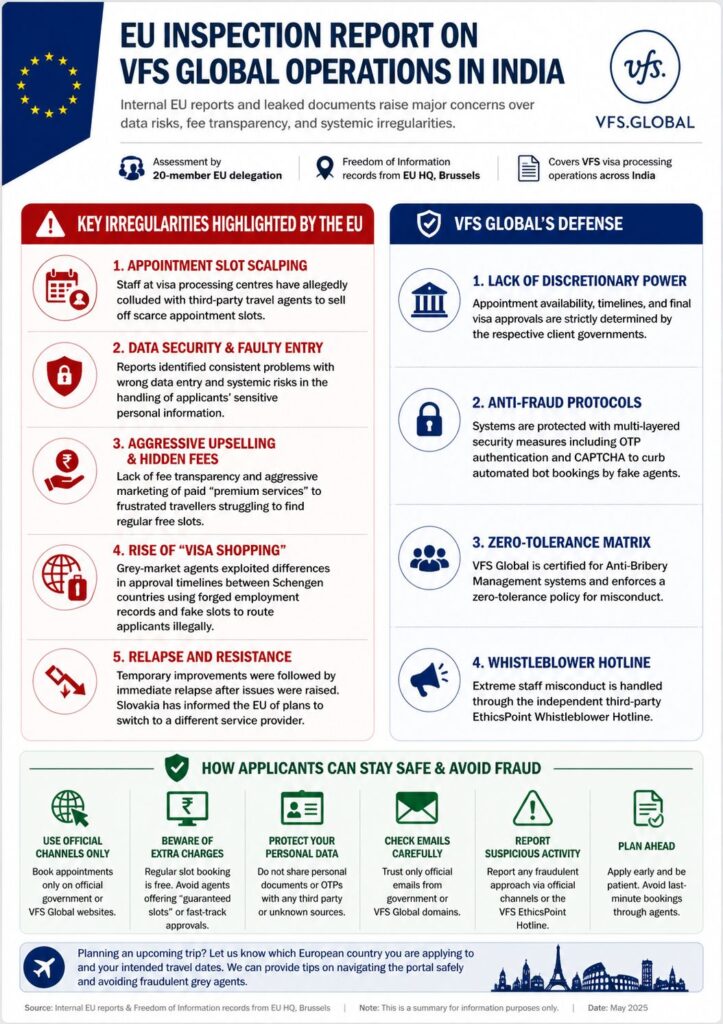
The reports document five years of persistent, recurring failures across VFS Global’s India operations — specifically its Visa Application Centres (VACs) in New Delhi and Mumbai. Crucially, the pattern is not isolated incidents. Every EU member state that flagged violations reported the same cycle: VFS would correct issues temporarily following inspection, then relapse into the same administrative failures within months. EU inspectors identified the root cause as severely under-equipped middle management and a critical lack of on-the-job supervision across VFS India operations.
A 20-member EU delegation visited India specifically to address these persistent shortcomings with VFS management — following extensive field assessments and structured questionnaires from 11 member states.
The Data Security Crisis: Biometric Data on Unencrypted CDs
The most serious category of findings involves how VFS handles the biometric data of Schengen applicants — data that includes fingerprints and photographs, collected at the VAC counter and transmitted to EU consulates.
How Was Indian Applicants’ Biometric Data Being Stored and Transferred?
EU inspection reports confirmed that biometric data and application documents were being stored on unencrypted compact discs during physical transport between VFS offices and consulates. The Schengen Visa Code mandates that applicant data must be deleted within 7 days of transmission to the consulate. The Hungarian consulate’s 2025 inspection found applicant data older than one month still accessible within the VFS New Delhi system — a direct violation of that mandate.
The Luxembourg Embassy’s 2023 inspection found something equally alarming: when processing errors occurred, VFS staff transmitted biometric information via open, unsecured email — unencrypted, with no access controls.
These are not edge cases. Biometric data — your fingerprints, your face — cannot be changed if compromised. If this data was accessed by an unauthorised party at any point during unsecured transport or email transfer, the exposure is permanent. The GDPR violations implied by these findings could carry fines of up to 4% of VFS Global’s annual global turnover under European data protection law.
Fake Appointment Slots and Bot Networks: How the System Is Being Gamed
Getting a VFS Global appointment for a Schengen visa in India — particularly at the Delhi and Mumbai centres during peak travel season — has become a problem in itself. EU inspection reports confirmed what applicants have reported on communities like Reddit’s r/SchengenVisa for years: appointment slots are being bulk-booked by paid bot networks and sold back at premium prices.
What Is the Scale of Fake Appointment Booking at VFS India Centres?
In some Indian cities, over 50% of booked applicants never showed up for their appointments. That figure — drawn directly from EU inspection reports — indicates systematic slot manipulation, not occasional no-shows. Travel agents exploit faster approval timelines by securing blocks of appointments through bots, then charging applicants for access to those slots — a practice entirely outside VFS’s official booking system.
This creates a two-tier access problem. Applicants who attempt to book through official VFS channels find no availability. Applicants willing to pay intermediaries get slotted in. The result is that queue access — a neutral administrative function — has been monetised outside the official fee structure.
The Optional Services That Didn’t Feel Optional: VAS Coercion at Delhi and Mumbai
VFS Global’s Value-Added Services include premium lounges, SMS status alerts, courier passport delivery, and form-filling assistance. Every one of these services is officially optional — they have no connection to visa approval decisions or processing timelines. However, applicants at the Delhi and Mumbai centres allege they were not told this clearly.
What Did the Swedish Mission’s 2025 Mumbai Inspection Actually Find?
The Swedish Mission’s 2025 inspection of VFS Mumbai found that the centre failed to clearly display that extra fees for premium services were strictly optional. Current and former VFS employees quoted in Moneycontrol’s May 29, 2026 report allege that staff were incentivised to routinely promote these services — and that the presentation at the counter made services appear necessary for a successful application.
The commercial logic is transparent: VFS’s VAS business in India carries pre-tax margins of up to 70%. When an applicant pays ₹1,500 for a premium lounge they believe is required, VFS keeps a significant share. Swiss auditors additionally criticised VFS’s refund handling for incorrectly charged applicants — one auditor stated that the reimbursement process “does not work at all.”
What VAS services are optional and have zero impact on your visa decision:
- Premium/luxury lounge access at the VAC
- SMS status update alerts
- Courier passport delivery to your home address
- Form-filling or document-checking assistance at the counter
You are entitled to apply for a Schengen visa at a VFS Global centre paying only the mandatory Schengen visa fee (€90 for adults, €45 for children 6–12, free for children under 6) plus VFS’s official service charge (approximately ₹1,800). Any service beyond this is optional.
Visa Shopping, Forged Documents, and Processing Errors at New Delhi VAC
What Is Visa Shopping and How Does It Work Through VFS India?
Visa shopping occurs when applicants apply through the consulate of a Schengen country with faster approval rates — rather than the country they primarily intend to visit. Travel agents facilitate this by routing applications strategically. It violates Schengen jurisdiction rules: you are required to apply at the consulate of your primary destination country or, for equal-length stays, the country of first entry. EU inspection reports confirmed visa shopping is now widespread in India, facilitated partly through VFS’s multi-country service contracts.
What Processing Errors Were Found at VFS New Delhi — the Worst-Performing Centre?
EU inspection reports identified VFS New Delhi as the VAC with the highest concentration of processing errors across all Indian centres. Specific findings include documents not arranged in the correct sequence before transmission to consulates, scanning errors that affected application files, IT infrastructure and bandwidth failures causing processing delays, and — most remarkably — Swiss inspection of the BFS New Delhi facility found passports dating back to 2020 still physically present and unreturnred.
EU reports also found forged employment contracts submitted as supporting documents in work visa applications processed through VFS India, raising questions about document verification protocols.
What the EU Is Doing About It — and What Comes Next
The European Commission recently adopted a new EU Visa Policy Strategy. A key stated focus: “The growing reliance by Member States on External Service Providers calls for improved quality control and monitoring.” This is direct institutional acknowledgment that the current oversight framework for companies like VFS Global is insufficient.
What Regulatory Changes Are Coming for VFS Global and Other ESPs?
The Commission has signalled a shift toward tighter regulation of External Service Providers (ESPs) — the category covering VFS Global, BLS International, and TLScontact. Specific measures under review include mandatory encryption standards for biometric data handling, stricter data retention auditing, cap on VAS fees, and clearer signage requirements at VACs indicating which services are optional.
Additionally, the EU Entry/Exit System (EES) — a new digital border system fully operational from April 10, 2026 — requires biometric registration at EU borders for all third-country nationals. This expands the volume of biometric data VFS and its competitors handle, making the data security failures documented in these reports more consequential, not less.
Skip the Mumbai Traffic! Get Visa Assistance at Your Doorstep
No need to visit our office. Our specialists will visit your home or office for document verification and processing.
*Additional service charges applicable based on your location.
The Siddhivinayak Tours and Travels Schengen Document Integrity Protocol
Before submitting any Schengen visa application through VFS Global, run this four-point check to avoid the processing errors flagged most frequently in EU inspection reports at VFS New Delhi:
1. Sequence lock — Arrange documents in the exact checklist order published by the specific Schengen country’s consulate. VFS New Delhi has the highest document mis-sequencing error rate of any VAC in the India network.
2. Biometric appointment verification — Book your appointment only through visa.vfsglobal.com. Screenshot your confirmed booking reference. If you are redirected to pay a third party for slot access, exit immediately and report to the consulate.
3. VAS refusal script — At the counter, if offered any premium service, you are entitled to state: “I am aware these services are optional and I choose to decline.” Under the Swedish Mission’s 2025 finding, VFS Mumbai was required to make this option clearer — you can invoke it directly.
4. Post-submission data confirmation — After biometric submission, request written confirmation of your application reference number and the date your biometrics were captured. This creates a timestamp record if a data retention complaint becomes necessary.
For complete Schengen visa application assistance from Mumbai, Siddhivinayak Tours and Travels guides applications through VFS Global Mumbai at Bandra Kurla Complex — document audit completed within 48 business hours, full checklist verification before counter submission, and written guidance on VAS services you are not required to purchase.
Pro Tip: If you are applying for France, Italy, Germany, or Spain as your primary Schengen destination, apply at the correct country’s consulate — not whichever centre has earlier appointment availability. Visa shopping is flagged in EU inspection reports and can result in your application being referred to the correct consulate, delaying your entire travel timeline.
Is VFS Global safe to use for Schengen visa applications in 2026?
VFS Global remains the only authorised submission route for most Schengen visas from India — there is no alternative channel for the majority of EU member state applications. However, the EU investigation findings mean you should be aware of your rights: VAS services are optional, your biometric data has specific legal protections under the Schengen Visa Code, and complaints should be filed directly with the consulate rather than through VFS.
What exactly did the EU investigation find about VFS Global in India?
Over 150 internal EU inspection reports from 2020 to 2025 documented biometric data stored on unencrypted compact discs, data transmitted via unsecured open emails, Schengen Code violations for data retention beyond the 7-day deletion window, fake appointment slots booked by bot networks, forged employment documents in visa applications, and systematic failure to clearly disclose that premium services are optional — all at VFS Global’s India centres.
Who owns VFS Global and is it a government body?
VFS Global is a private company, not a government entity. It is majority-owned by Blackstone, the world’s largest alternative asset management firm. VFS holds outsourcing contracts with 68 governments but makes its own operational and commercial decisions. Its Value-Added Services division commands pre-tax margins of up to 70% in India.
Are the premium services at VFS Global — like the lounge or SMS alerts — mandatory?
No. Every VFS Global Value-Added Service — including premium lounge access, SMS status alerts, courier passport delivery, and form-filling assistance — is strictly optional. None of these services have any connection to visa approval decisions or processing speed. You are required to pay only the Schengen visa fee (€90 for adults) and VFS’s official service charge (approximately ₹1,800).
What is visa shopping and is it illegal?
Visa shopping is applying at the consulate of a Schengen country with faster approval rates rather than the country you primarily plan to visit. It violates Schengen jurisdiction rules. EU inspection reports confirmed it is widespread in India and is facilitated by travel agents who exploit approval rate differences. If caught, your application can be referred to the correct consulate, invalidating your timeline.
What are my rights regarding biometric data submitted to VFS Global?
Under the Schengen Visa Code, VFS Global is required to delete your biometric data — fingerprints and photograph — within 7 days of transmitting your application to the relevant consulate. The 2025 Hungarian consulate inspection found VFS New Delhi holding data older than one month, in direct violation of this mandate. You can request confirmation of your biometric data deletion in writing from the applicable consulate.
Which VFS Global centre in India has the worst performance record?
EU inspection reports identified VFS New Delhi (Barakhamba Road) as the Visa Application Centre with the highest concentration of processing errors in India — including document mis-sequencing, scanning failures, IT infrastructure problems, and data retention violations. Swiss inspectors also found passports dating back to 2020 still physically present at the BFS New Delhi facility.
Can I complain about VFS Global if I was pressured to buy optional services?
Yes. File your complaint directly with the consulate of the Schengen country you applied to — not through VFS Global’s own feedback channels. Consulate complaint desks operate independently of VFS. If you were incorrectly charged for a VAS service, submit a written refund request with your transaction reference number to VFS. Keep all receipts and counter documentation as evidence.
How does the EU Entry/Exit System (EES) affect Schengen visa applications from India?
The EU Entry/Exit System became fully operational on April 10, 2026. It replaces manual passport stamping with biometric registration at EU borders — fingerprints and a photograph — for all third-country nationals, including Indians. This registration happens at the EU border on your first entry, not at VFS during your visa application. There is no additional cost for EES registration. However, it means the volume of biometric data being handled by border infrastructure — and by ESPs like VFS during application processing — has increased significantly.
You Still Need to Apply Through VFS — Here’s How to Do It Right
The investigation changes what you know. It does not change where you apply. VFS Global remains the only authorised Schengen visa submission channel for Indian nationals for most EU member states. What has changed is your leverage as an applicant.
Siddhivinayak Tours and Travels guides Schengen visa applications through VFS Global Mumbai at Bandra Kurla Complex — with a document audit completed within 48 business hours before counter submission, full checklist sequencing for the specific country’s consulate requirements, and written briefing on which VAS services you are not obligated to purchase.
Minimum lead time for Schengen applications: 6 weeks before travel. Peak holiday periods (November–January, March–April) require 8 weeks. Do not book flights before your visa appointment is confirmed.
📞 Starting a Schengen application? Get in touch today. We’ll prepare your documents, book your VFS appointment through the official portal, and brief you on every right you have at the counter.
Talk to Our Schengen Visa Team →
Sources: Indian Express / Lighthouse Reports · Moneycontrol · BusinessToday · Moneylife · Mint